Posts

Missionary Journeys of Paul

Image
Paul’s journey to Rome that concludes the book of Acts is one of the most exciting stories in ancient literature. It recounts the fateful shipwreck that occurred west of Crete, and ends in Rome, the seat of the Christian world for over 1500 years. Before he and his followers came to Rome, however, two of Paul’s missionary journeys came to Greece, where his work formed the foundation of some of Christianity’s earliest congregations. we will visit Thessalonica, Philippi, and Berea where Paul established churches on his second journey. We stop at Neapolis to walk on a well-preserved section of the ancient , the Via Egnatia. We will visit Actium – where Octavian defeated Antony and Cleopatra in the famous battle in 31 B.C., and nearby Nicopolis, where Paul spent the winter.   THESSALONICA. Paul established the church here on his second journey (Acts 17:1-9) and later wrote two letters to the Thessalonians.    ACTIUM, NICOPOLIS and Museum - Preveza. Our...

Has the Childhood Home of Jesus Been Found. Jesus’ home in Nazareth

Image
  This very well could be the childhood home of Jesus. It doesn’t look inviting, but this rock-hewn courtyard house was quite likely Jesus’ home in Nazareth. The recent excavation by Ken Dark and the Nazareth Archaeological Project revealed evidence suggesting this is where Jesus was raised—or at the least the place venerated as such by the Byzantine period. Photo: Ken Dark. The childhood home of Jesus may have been found underneath the Sisters of Nazareth Convent in Nazareth, Israel, according to archaeologist Ken Dark. The excavation site located beneath the convent has been known since 1880, but it was never professionally excavated until the Nazareth Archaeological Project began its work in 2006. In “Has Jesus’ Nazareth House Been Found?” in the March/April 2015 issue of BAR, Ken Dark, the director of the Nazareth Archaeological Project, not only describes the remains of the home itself, but explores the evidence that suggests that this is the plac...

Where Did Jesus Turn Water into Wine? Finding Cana of Galilee, site of Jesus’ first miracle

Image
  Where did Jesus turn water into wine? Excavations at Khirbet Cana in lower Galilee provide compelling evidence that the town where Jesus’ first miracle was performed has been found. The discovery of a large Christian underground veneration complex suggests that the site may have been worshiped as Cana of Galilee by early Christians since the fifth century C.E. Photo: Courtesy Khirbet Qana Project. On the third day there was a wedding in Cana of Galilee, and the mother of Jesus was there. Jesus and his disciples had also been invited to the wedding. When the wine gave out, the mother of Jesus said to him, “They have no wine.” And Jesus said to her, “Woman, what concern is that to you and to me? My hour has not yet come.” —John 2:1-4 Jesus’ first miracle was performed in Cana of Galilee. When the wedding party in Cana ran out of wine, Jesus commanded the servants to fill up six stone jars with water. After he is offered a cup from one of the jars, the...

Israel Sea of Galilee Tabgha Church of the Multiplication of Loaves and Fishes Mark 6:41.

Image
Background: Tabcha (Ein Sheva) is a place in the north-west section of the Sea of Galilee which is blessed by seven springs. The area of Tabcha (Ein Sheva) was one of the best places in the Sea of Galilee for fishing. Some of the seven springs are warm sulfuric springs, such as Ein-Nur and Ein-Ayub (Job's spring). This caused the fish to gather here, especially in the cold winter months, and so were an easy catch for the fishermen. The waters from the springs were delivered to the fields and villages around using aqueducts. Near the springs there are pools that were used to raise the level of the water in order to deliver them via the aqueducts. The waters were also used for powering water based bread mills. The last bread mill worked here until 1948. The site is an important pilgrimage place: according to the tradition, Jesus performed here two miracles: first feeding of the ...

How Ancient Jews Dated Years

Image
During the First Jewish Revolt against Rome (66–70 C.E.), which ended with the destruction of the Temple, Jews minted their own coins dated to the first, second, third, fourth and, more rarely, even fifth year of the revolt. In other words, dating began with the beginning of the revolt. Many of the coins also bore legends like “Jerusalem the Holy” or “Freedom of Zion.” The Romans crushed the Jewish revolt in 70 C.E. ( except for the holdouts at Masada , among other places), but the Jews managed to revolt again a little more than 60 years later. This revolt, the so-called Bar-Kokhba Revolt (132–135 C.E.) , a lasted only two-and-a-half years. And the coins from this revolt are much rarer. As in the first revolt, however, coins are dated beginning with the start of the revolt. An example is a coin inscribed, “Year 1 of the Redemption of Israel,” or another inscribed, “Year 2 of the Freedom of Israel.” Rarely, a coin bears the legend “Year 3 of the Redemption of Israel.” ...

The Masada Siege The Roman assault on Herod’s desert fortress

Image
Masada—for many, the name evokes the image of a cliff rising dramatically above an austere desert landscape . The name is famously associated with the Masada siege , the final stand between the Jewish rebels and the relentless Roman army at the end of the First Jewish Revolt in 73/74 C.E. Trapped in the desert fortress-palace Herod built in the previous century, the rebels chose—as Jewish historian Josephus tells us—to commit mass suicide rather than be captured and enslaved by the Romans. This final scene in the siege of Masada has been celebrated and immortalized as an act of heroic resistance on the part of the Jewish rebels. But what do we know about the Roman siege itself? In “The Masada Siege—From the Roman Viewpoint” in the July/August 2014 issue of Biblical Archaeology Review , Gwyn Davies examines the assault from the Roman perspective. After the fall of Jerusalem in 70 C.E., the Romans turned their attention to stamping out the last of the rebels holding out at ...

A Second Triumphal Arch of Titus Discovered

Image
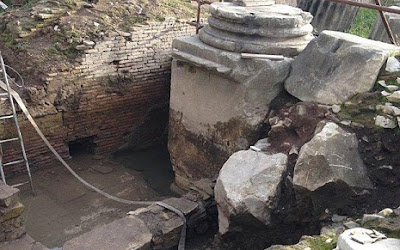
Archaeologists in Rome have discovered the foundations of a second triumphal arch of Roman Emperor Titus, which was thought to be lost to history, the Telegraph reports . The arch once stood at the entrance to ancient Rome’s chariot-racing stadium, the Circus Maximus. A member of the Flavian dynasty, Titus was emperor of Rome from 79 to 81 A.D. Even though he responded quickly with aid when Vesuvius erupted barely two months into his reign in 79 and is credited with completing the Colosseum in 80, it is the destruction of the Temple in Jerusalem and his victory against the Jews in 70 when he was just a general that has made Titus one of the more well-known figures in Roman history.   The excavation site of a second triumphal arch of Titus in Rome’s Circus Maximus. Photo: Courtesy the Telegraph. Scenes of Titus’s victory in Judaea—culminating with the destruction of the Temple in Jerusalem—decorate the world-famous monumental Arch of Titus that stands on the Vi...